Custom CRM Development Cost in India: A Straight 2026 Guide
23-07-2026
The most-asked question in our first sales call is not "what will the CRM do." It is "what will it cost."
Fair question. Nobody publishes a price list, most agencies quote in ranges wide enough to drive a truck through, and the same feature list can cost ₹4 lakh or ₹40 lakh depending on who is quoting and what they are actually including.
This guide gives you the honest numbers for 2026 India. Real ranges, what pushes cost up, what pushes it down, and the hidden costs nobody warns you about until you have already signed.
The short answer
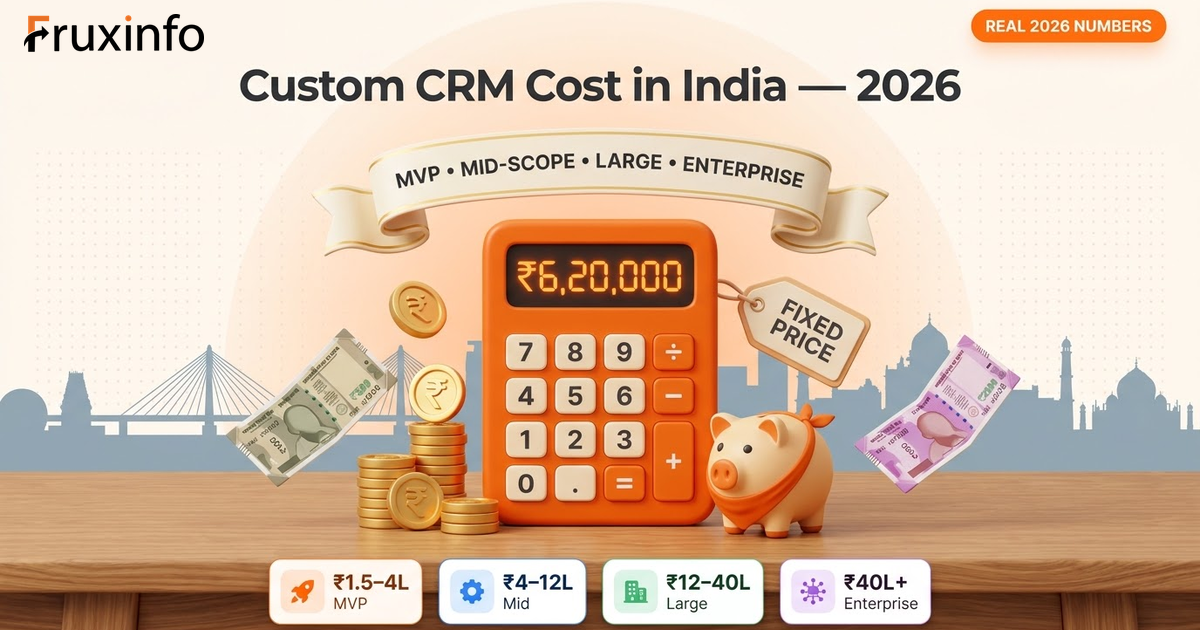
A custom CRM in India in 2026 costs, roughly:
- Small scope (MVP CRM, 3–5 modules): ₹1.5 to ₹4 lakh
- Mid scope (10–15 modules, integrations, mobile web): ₹4 to ₹12 lakh
- Large scope (full custom, native mobile, complex workflow): ₹12 to ₹40 lakh
- Enterprise scope (multi-region, ERP-level integrations): ₹40 lakh and up
Timeline scales with scope — 4 weeks for the smallest MVP, 3 to 6 months for mid-scope, 6 to 12 months for large. Nobody serious builds a real custom CRM in "one week" no matter what LinkedIn ads promise.
1. What actually drives the cost
CRM development is not priced per feature — it is priced per hour of developer time. So anything that changes how many hours the build takes, changes what you pay. Six things drive that hour count:
a. Number of modules
A "module" is a distinct area of the CRM — leads, contacts, deals, quotations, invoices, tasks, calendar, reports, user management, roles and permissions, notifications, dashboard, integrations panel. A small business CRM has 5 to 8 modules. A mid-size one has 10 to 15. Enterprise CRMs can have 30+.
b. Complexity of the sales / workflow logic
A textbook lead-to-deal pipeline is cheap to build. A textile-order pipeline that handles yarn allocation, loom availability, dyeing, quality check, invoicing, and dispatch is not. Same word — "pipeline" — very different build.
c. Integrations
Each external system your CRM speaks to adds cost. Tally integration, WhatsApp Business API, IndiaMART lead sync, Justdial lead sync, courier APIs, payment gateway, email marketing tool, ERP, SAP, factory scanner — every connection is between one and three weeks of engineering by itself.
d. Mobile
Responsive web CRM (opens on mobile browser) is included in most builds. A dedicated native Android or iOS app is a separate project on top of the CRM — typically ₹3 to ₹10 lakh depending on how much of the CRM the app needs to expose.
e. Users and permissions
A single admin CRM is simple. A CRM with sales, sales manager, admin, accounts, dispatch, and reporting roles — each with different visible fields, edit permissions, and dashboards — takes real design work. Complex role hierarchies can add 10 to 20 percent to the base cost.
f. Design and UX polish
A functional-but-plain CRM is the fastest to build. A CRM with a clean designed UI, thoughtful empty states, animated feedback, and a dashboard that a founder actually enjoys opening — that takes a designer plus more engineering time. Budget an extra 15 to 25 percent for a genuinely designed CRM instead of a wireframe-with-colours.
2. A real cost breakdown
Here is what a typical mid-scope custom CRM build looks like — the kind we ship for a 15-to-40-person business in Ahmedabad, Rajkot, Surat, or Vadodara.
| Stage | What happens | Typical share of budget |
|---|---|---|
| Discovery & scoping | Interviews with your team, mapping current workflow, listing every module, defining fields and rules. | 5–10% |
| UI/UX design | Wireframes, then full designs for every screen. Sign-off before code. | 10–15% |
| Backend development | Database schema, business logic, APIs, authentication, roles, permissions. | 30–40% |
| Frontend development | Every screen coded, forms, tables, dashboards, filters, exports. | 25–30% |
| Integrations | Tally, WhatsApp, IndiaMART, payment, courier — whatever you need. | 10–20% |
| Testing & bug fixing | QA, user acceptance testing, fixes. | 5–10% |
| Deployment & training | Hosting setup, data import, team training, go-live support. | 5% |
Notice: only 30 to 40 percent of the cost is backend code. Half your budget goes into design, frontend, integrations, and testing. Any quote where "development" is 90 percent of the cost is skipping something you will pay for later.
3. Where the quotes go wrong
a. Quotes that look too cheap
If someone offers you a "full CRM with mobile app and Tally integration for ₹80,000", they are quoting for one of three things:
- A rebranded off-the-shelf CRM (not really custom).
- A stripped MVP that will need three more phases of work to become useful.
- A price that will double or triple during the project via "change requests".
Real custom CRM development in India starts at ₹1.5 lakh for the smallest useful build. Below that number, you are getting a template with your logo on it.
b. Quotes that look reasonable but exclude the hard parts
Read every quote for what it does not include:
- Data import from your current system (spreadsheets, Zoho, Excel)
- Training your team
- First-year hosting and maintenance
- Mobile app (as separate line item)
- Integrations (often listed as "one integration included, additional ₹X each")
- Custom reports beyond a fixed number
A quote that lists all of these up front — even if the number is higher — is more honest than a lower quote that adds them one by one after the contract is signed.
c. Hourly quotes without a hour estimate
"₹1200 per hour, we will estimate as we go" is not a quote. That is a blank cheque. Always insist on a fixed-scope, fixed-price contract for the first version, with clear terms for change requests after go-live.
4. Recurring costs (the part everyone forgets)
The build cost is one-time. The CRM has running costs too. Budget these for year one and beyond:
| Recurring item | Typical yearly cost | Notes |
|---|---|---|
| Hosting (VPS or cloud) | ₹15,000 – ₹60,000 | Higher for busier CRMs or higher-availability needs |
| Domain | ₹800 – ₹2,000 | Often included year one |
| SSL | Free (Let's Encrypt) or ₹3,000+ | Let's Encrypt is fine for internal CRMs |
| Backups | ₹5,000 – ₹15,000 | Daily off-site backup is worth it |
| SMS / email / WhatsApp gateway | Pay-per-message | Depends on volume — budget ₹5,000+/month for active teams |
| Maintenance retainer | ₹8,000 – ₹40,000 / month | Bug fixes, small tweaks, minor features. Optional but recommended. |
| Third-party APIs | Varies | Google Maps, payment gateway fees, courier APIs — pass-through |
Compare this to Zoho or Salesforce, where you pay per user, per month, forever. A twenty-user Zoho subscription is around ₹6 lakh per year. A custom CRM's ongoing costs top out at maybe ₹1.5 lakh a year including a good maintenance retainer. That is where custom pays for itself over time.
5. Timeline — how long does it really take
- MVP CRM (5–8 modules, no mobile, one integration): 4 to 6 weeks.
- Mid-scope (10–15 modules, mobile-responsive, 2–3 integrations): 8 to 16 weeks.
- Large scope (native mobile app, 5+ integrations, complex workflow): 4 to 9 months.
- Enterprise (multi-region, ERP-grade, compliance): 9 to 18 months, with phased releases.
A CRM built in a hurry usually gets rebuilt in a year. A CRM built at a sensible pace, with real discovery and real testing, lasts five to ten years.
6. How to keep the cost sensible
Phase your build
Do not try to launch everything in version one. Launch a Phase 1 with your five most-used modules. Live for three months. Then decide Phase 2 based on what the team actually asked for after using it, not what you imagined they would need before.
Standardise where you can, customise where it matters
Standard login screens, standard user management, standard email notifications — no need to reinvent. Save custom effort for the parts that are actually unique to your business.
Buy the fields, not the software
You are not paying us to write a CRM. You are paying us to encode your process into software. The clearer you are about your fields, stages, roles, and reports before we start, the less time we spend guessing — and the lower your bill.
Reuse rather than rebuild
A good development team has a library of tested components — user login, role management, invoicing, reporting engine, notification system. Reusing those saves you weeks of development time you would otherwise pay for. Ask your vendor whether they are starting from scratch or from a mature foundation.
7. When the higher quote is the right choice
Sometimes the ₹8 lakh quote is a better buy than the ₹3 lakh quote, and it takes experience to see why.
- The higher quote includes a designer, not just developers. That shows up every day for the next decade.
- The higher quote includes real testing time. The cheaper one ships bugs to your live team.
- The higher quote uses a modern, maintainable stack. The cheaper one uses whatever the developer already knows, even if it is hard to hire for in three years.
- The higher quote comes from a team that has shipped CRMs for your industry before. The cheaper one will figure your industry out on your dime.
Get three quotes. Ignore the highest and the lowest. Ask the middle one what the highest one includes that they left out.
How Fruxinfo prices CRM builds
We give a fixed scope and fixed price after a two-part discovery call — first call to understand your business, second call to walk you through the module list, integrations, timeline, and price. That quote does not change unless you change the scope. If you do, we quote the change before we do it, so you always know the running total.
Most of our CRM projects sit in the ₹4 to ₹15 lakh range for mid-size Gujarat businesses. Complex projects go higher; MVP builds go lower. What every project gets is: a designer on the build, a real QA pass before you see it, data import from your current system, team training, and a maintenance option for after go-live.
If you want an actual number for your business, tell us about your process — send whatever you can about your current CRM or spreadsheet, your team size, and what is not working. We come back within two working days with a scope and price, not a range.
You can also read how we approach custom CRM development — what we build, how we scope, and what "custom" actually means when we say it.
The bottom line
Real custom CRM in India in 2026 costs between ₹1.5 lakh (MVP) and ₹40 lakh (large enterprise scope), with most mid-size businesses landing at ₹4 to ₹15 lakh. Timelines run from four weeks to nine months. Recurring costs are a fraction of Zoho or Salesforce subscription fees over the same period.
The quote alone tells you almost nothing — read what it includes, what it excludes, who is on the team, and how they handle change requests. That is where the real price lives.
Related Services
Want to put these ideas into practice? Talk to Fruxinfo Ahmedabad about: