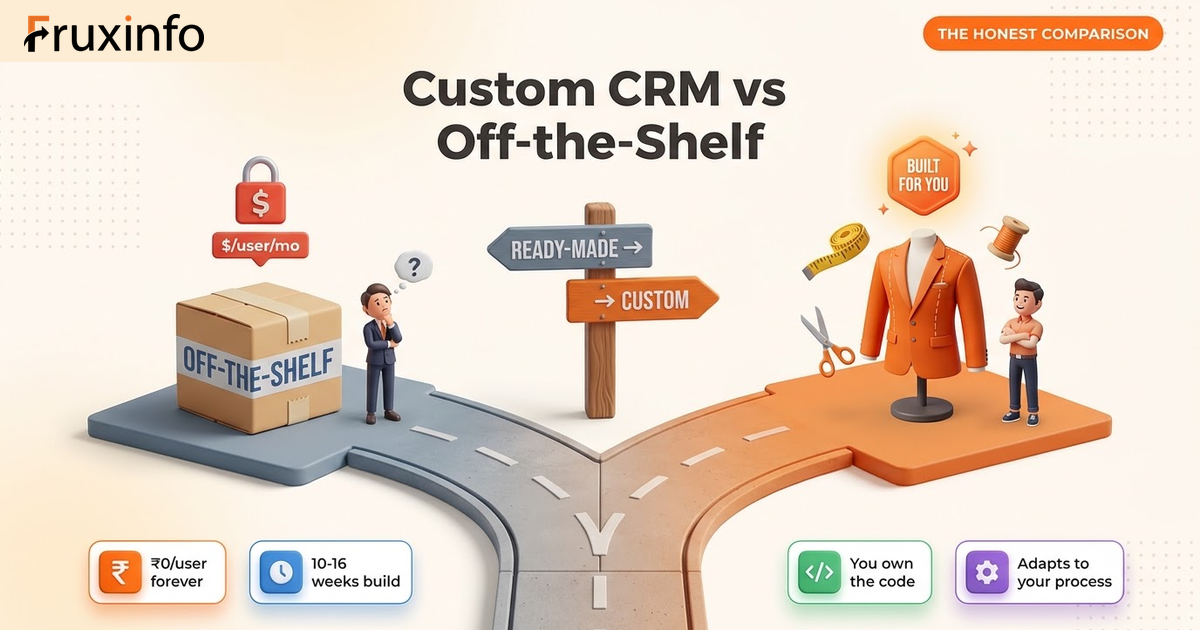
Custom CRM vs Off-the-Shelf CRM: The Honest Comparison
23-07-2026
Custom or off-the-shelf? It is one of the first big decisions when your business outgrows spreadsheets. Get it right and the CRM disappears into the background. Get it wrong and you spend two years wrestling with software that does not fit — or over-paying for a build you did not need.
Most comparisons on this topic are written by whoever wants to sell you their side. This one is not. Both options are the right answer for the right business — the question is which is right for yours.
Quick definition
Off-the-shelf CRM — Zoho, Salesforce, HubSpot, Freshsales, Sell.Do, LeadSquared, and a hundred others. Pre-built software you configure and pay per user per month.
Custom CRM — software built specifically for your business by a development team. You own it. You pay once (or in milestones), not per user forever.
Off-the-shelf CRM wins when…
1. Your process is standard
If your sales flow looks like textbook B2B — lead lands, gets qualified, becomes a deal, deal has stages, deal closes, deal generates invoice — off-the-shelf handles this in its sleep. No reason to build custom.
2. You want to be live in a week
Zoho you can set up in a weekend. Custom takes 4 to 16 weeks minimum. When time-to-live matters more than fit, ready-made wins.
3. You have fewer than 10 users
The per-user subscription math works out at low team sizes. Below 10 users, off-the-shelf is cheaper than custom for the first three years.
4. You have no tech team internally
Off-the-shelf CRMs come with vendor support, help documentation, YouTube tutorials, third-party trainers. Custom CRMs need someone who understands them enough to answer team questions.
5. Your industry is well-covered
If you sell software, real estate, insurance, or consumer products, there are ready-made CRMs designed for you. They usually beat what a general-purpose custom build would do.
6. You need enterprise features you would not build yourself
Salesforce has 20 years of features around forecasting, territory management, multi-currency, compliance, and enterprise reporting. Building all of that custom is a multi-year commitment. If you need it, buy it.
Custom CRM wins when…
1. Your process is not standard
Textile brokerage flows, manufacturing production stages, real estate site visits with channel partners, healthcare patient journeys, pharma compliance tracking — the more your business deviates from generic B2B sales, the more you pay in "custom fields" and "workarounds" on off-the-shelf. At some point, custom is cheaper and cleaner.
2. You have 15+ users, planning to grow
Per-user subscriptions punish scale. 15 users at ₹3,000/month is ₹5.4 lakh/year, ₹27 lakh over five years — with nothing owned at the end. That budget builds a mid-scope custom CRM in one shot.
3. You need integrations off-the-shelf handles badly
Tally integration, WhatsApp Business API with logging, IndiaMART auto-sync, factory-floor scanner, in-house ERP — some of these have shaky third-party connectors on Zoho/Salesforce or are missing entirely. Custom lets you build the integration exactly how you want.
4. You want reports in your shape, not their shape
Every CRM has "reports". Getting a report in the exact structure your MD asks for — filtered by your criteria, grouped by your dimensions, exported in your format — is often surprisingly hard on off-the-shelf. Custom starts from your reports and builds outward.
5. You want to own the software
Off-the-shelf is a rental. If the vendor raises prices, changes terms, or gets bought by a company that changes direction, you have limited leverage. Custom = you own the code, the database, the roadmap.
6. You already tried off-the-shelf and it did not stick
The strongest signal for custom is a previous ready-made CRM your team abandoned. That is data — it means the shape did not fit. Trying another ready-made is the same shape in a different colour. Custom is the different shape.
Side-by-side comparison
| Dimension | Off-the-Shelf CRM | Custom CRM |
|---|---|---|
| Time to live | Days to weeks | 4 to 16 weeks (mid-scope) |
| Upfront cost | Very low (setup fees) | Higher (₹4–15 lakh mid-scope) |
| Ongoing cost | Per user / month, forever | Hosting + maintenance (₹1–2 lakh/year) |
| 5-year cost, 20 users | ₹30 lakh+ (Zoho), ₹1.6 crore+ (Salesforce) | ₹6 – 20 lakh one-time + hosting |
| Fit with unusual workflow | Limited — you adapt to it | Excellent — it adapts to you |
| Time to change / add feature | Configurable within limits | Whatever you can describe, we can build |
| Vendor lock-in | High — hard to migrate out | Low — you own the code |
| Data ownership | Vendor-hosted (usually) | Your hosting, your data |
| Integrations | Marketplace + custom code | Built to your exact stack |
| Learning curve | Moderate to steep | Low — matches team's mental model |
| Enterprise features | Deep (Salesforce especially) | Only what you build |
| Roadmap control | Vendor decides | You decide |
The hidden costs on each side
Hidden costs of off-the-shelf
- Implementation partner fees (₹1–20 lakh depending on complexity)
- Add-on licences (marketing, analytics, mobile SDK)
- Third-party connectors (WhatsApp gateway, IndiaMART sync)
- Annual per-user increases (5–15% is standard)
- Migration cost if you outgrow it in three years
- Custom-field engineering hours if you configure it heavily
Hidden costs of custom
- Discovery + design phase (people underestimate this)
- Change requests during build (scope drift)
- Hosting, backups, monitoring after go-live
- Maintenance retainer for ongoing tweaks
- Team training
- Bug window in first month post-launch
A good vendor on either side tells you the hidden costs up front. A vendor who "just gives you a low price" is charging for the hidden costs later.
The most common mistake
Founders often decide based on the sticker price of month one.
"Custom is ₹6 lakh, Zoho is ₹6,000 a month. Zoho, obviously."
Six thousand a month for 20 users over 5 years = 20 × 3000 × 60 = ₹36 lakh (assuming the low tier and no price increases — realistic is more). Plus setup, plus add-ons, plus the fact that after 5 years you still own nothing.
Custom at ₹6 lakh for the build + ₹1.5 lakh/year hosting and maintenance = ₹13.5 lakh over 5 years. With software you own.
The right way to compare is 3-year and 5-year total cost, not month-one cost.
A decision framework
Ask yourself six questions.
- Does your sales / delivery process fit a standard B2B template?
- Do you have fewer than 10 users, unlikely to grow past 20?
- Are you fine with paying per user, per month, forever?
- Do you need to be live in under a month?
- Is your industry well-served by an existing ready-made CRM (real estate, insurance, tech sales, e-commerce)?
- Do you have no in-house tech team to co-own a custom build?
5–6 yes: Off-the-shelf. Zoho or a vertical-specific SaaS is the right call. Do not overbuild.
3–4 yes: Borderline. Get a custom quote and a real Zoho / Salesforce implementation quote for comparison — the numbers will surprise you.
0–2 yes: Custom is almost certainly the right call. Off-the-shelf will slowly become the thing your team resents.
Hybrid: sometimes the answer is both
Some businesses use both:
- Off-the-shelf for a specific function it does well (e.g., HubSpot for marketing automation)
- Custom for the core operational CRM where fit and ownership matter
The two talk to each other via API. This works well when a ready-made tool is genuinely best-in-class for one function, but nothing on the market covers your core operations properly. It also increases integration cost and complexity — worth it only when the specific ready-made tool is significantly better than what you would build.
Common ways teams pick wrong
1. Picking off-the-shelf to "save time now"
Then spending the next two years building workarounds. Would have been faster to invest 12 weeks in custom.
2. Picking custom for a plain-vanilla process
Then paying to build features Zoho already has. Should have taken the ready-made and moved on with life.
3. Picking based on the biggest brand
Salesforce is the biggest CRM brand. That does not make it the best CRM for a 15-person distributor in Rajkot. Big-enterprise software in a small business kills adoption.
4. Picking based on the demo, not the daily reality
Every CRM demo is impressive. Ask for a 15-day trial with real users, real leads, real deals. That tells you the truth.
5. Skipping the 5-year cost calculation
Compare on total cost over 5 years, not month one. This one calculation flips 30 percent of decisions.
How Fruxinfo advises
We build custom CRMs — that is our bias, and you should know it. But we do not think custom is right for every business, and we say so when it is not.
If we look at your process and think Zoho or Sell.Do (or another vertical SaaS) will fit you well, we tell you. We would rather send you to the right ready-made CRM than build you a custom one that solves a problem you did not have.
If custom is right for you, we scope it fixed, price it fixed, ship in 8 to 16 weeks for mid-scope, and stay engaged after go-live. You own the code, the data, and the roadmap.
Want an honest read on which is right for your business? Send us your process. We come back with a recommendation — custom or off-the-shelf — with reasoning, within two working days.
Related reading: custom CRM development, and our earlier post comparing Custom CRM vs Salesforce vs Zoho.
The bottom line
Both custom and off-the-shelf are correct answers. The question is which one is correct for you.
- Standard process, small team, no time for a build — off-the-shelf.
- Unusual process, growing team, integrations that matter, ownership that matters — custom.
- Somewhere in the middle — get both quotes, do the 5-year math, and pick honestly.
Pick right and the CRM becomes invisible infrastructure. Pick wrong and it becomes the thing your team blames for everything.
Related Services
Want to put these ideas into practice? Talk to Fruxinfo Ahmedabad about: