Textile Industry CRM: A Complete Guide for Surat Businesses
23-07-2026
Surat runs on textile. Yarn arrives from Mumbai, gets warped and wefted on 900,000-plus looms, gets dyed in Pandesara or Sachin, printed, cut, packed, and dispatched — all inside a 50-kilometre radius, all on razor-thin margins and one-day turnarounds.
A generic CRM designed for software companies has nothing useful to say to this business. Your "deal" is not a subscription. Your customer is a broker who deals in 4,000 metres today and 12,000 tomorrow. Your production is not a Kanban board with three columns — it is a physical flow through looms, dyeing, printing, cutting, and packing. And your entire communication with buyers happens on WhatsApp.
This guide covers what a textile CRM built for Surat actually looks like. What it must have, what off-the-shelf CRMs get wrong, and how to know when custom is the right call.
Why textile is not standard CRM territory
1. The buyer is a broker, not the end customer
Most of the fabric coming out of Surat is sold to brokers who serve wholesale markets across India — Kolkata, Delhi, Chennai, Bangalore, Ahmedabad's own Ashok Bhai Market. Brokers order in bulk, pay in cycles (30/60/90 days), and expect samples fast. Your CRM has to track the broker relationship, not "leads" in the software-sales sense.
2. Products are catalogues, not SKUs
You do not sell "Fabric #1247". You sell design 4712 in six qualities (chiffon, georgette, satin, crepe, dola silk, organza) each in four colourways. That is 24 variants of one design. And you may have 300 active designs at any time. A CRM that treats each variant as a separate "product" collapses under this catalog.
3. Sample catalogues drive sales
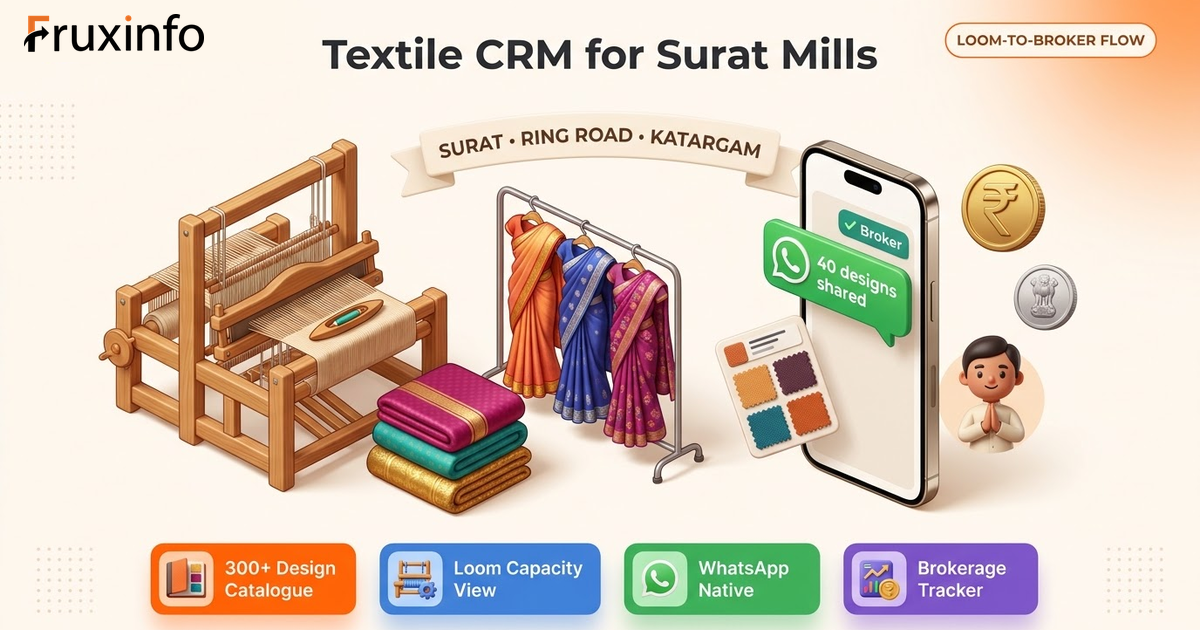
A broker asks for "latest sarees under ₹500". You need to send them a curated selection — 40 sample images, prices, minimum order quantities — via WhatsApp, within 20 minutes, from your salesperson's phone. That is not a "feature" in a standard CRM. It is the whole game.
4. Production is a physical, staged process
Order lands → yarn allocated → warp/weft loaded on looms → weaving → grey fabric off loom → dyeing / printing → finishing → cutting → packing → dispatch. Every stage takes time, has capacity limits, has bottlenecks. Your CRM needs to show where every order is in this flow, not just "In production."
5. Payment cycles are long and cyclical
Brokers pay on cycles. Some pay in 30 days, some 45, some 60, some 90. Some pay in cash, some in RTGS, some through hundi. Some months are peak (before Diwali, before wedding season) and payments flow. Some months are dry. Your CRM must track ageing and cycle-fit for every broker, not just "outstanding amount."
What a textile CRM must have
a. Design catalogue with image-first browsing
Your salesperson opens the CRM, filters by "chiffon under ₹450", picks 40 designs, and one-taps "Send to broker on WhatsApp". A PDF catalogue with images, codes, prices, and MOQs generates automatically and goes on WhatsApp. Track which broker got which catalogue and which designs they replied on.
b. Quality × Colour × Design matrix
Every enquiry, quote, and order should let you select a design, then a quality, then colours and quantities per colour. The CRM stores this as a matrix, not as one flat line — because a broker will order 500m of D-4712 in Chiffon Red + 200m Chiffon Peach + 300m Georgette Red + 400m Georgette Peach on one PO.
c. Production stage tracking
Warping → weaving → dyeing → printing → cutting → packing → dispatch. Every order shows its current stage, days in stage, expected completion. Overdue orders auto-alert the production head.
d. Loom / capacity view
How many looms are running which design? What is the backlog per loom? When can the next order be started? A CRM that shows loom utilisation lets the sales team promise realistic delivery dates instead of over-committing.
e. Broker profile with cycle + limit
Each broker has a credit limit, an average payment cycle, and a track record. When the sales team enters a new order, the CRM warns if the broker is already at limit or overdue. This one feature stops a lot of pain later.
f. WhatsApp-first communication
Surat textile does not do email. Everything is WhatsApp — enquiries, catalogue sharing, quote negotiation, payment reminders, dispatch photos. Your CRM must integrate with WhatsApp Business API so every WhatsApp conversation with a broker is logged on their record.
g. Ageing and outstanding by broker
Show the accounts team: broker-wise outstanding, aged 0–30, 30–60, 60–90, 90+. Filter for "overdue past cycle length." One click, list of brokers to chase this week.
h. Broker commission / dalali
Textile deals have brokerage / dalali built in. Track it — per broker, per deal, per month — so that at month-end, brokerage payouts are automatic instead of a manual reconciliation nightmare.
i. Multi-user with roles
Sales, sales manager, production planner, dyeing supervisor, dispatch, accounts, admin. Each sees only what they should. Salespersons see their brokers. Managers see their team. Accounts sees payments. The production team sees the production board.
j. Native mobile
Your salespersons are in the local textile market, at broker offices, on the phone all day. The CRM has to run smoothly on their phone — quick catalogue sends, quick order entry, quick "share dispatch photo".
What off-the-shelf CRMs get wrong for textile
- No design catalogue browser. You end up uploading spreadsheets of "products" that nobody references.
- Weak variant handling. Fixed dropdowns for colour or quality do not map to the reality of 40 dye colours × 12 fabric types.
- Sample-catalogue sharing is manual. No PDF-with-images generation, no "send to WhatsApp" one-tap.
- Production stages do not exist. You get "Deal Stage: Won / Lost" — nothing about warp / weave / dye / dispatch.
- Loom capacity: not a concept. Standard CRMs cannot show you which loom is free.
- Brokerage tracking: absent. Or requires a paid add-on that still cannot handle Surat's compensation styles.
- WhatsApp integration: available, but shallow. Third-party WhatsApp connectors miss the tight loop textile needs.
You can force a Zoho or a Salesforce to work by adding custom fields, custom modules, and custom scripts. But the software fights you every step. In every textile CRM implementation we have taken over from someone else, the team was quietly using WhatsApp and Excel on the side.
Custom textile CRM — what a typical build looks like
A mid-size Surat textile business (150–400 looms, 10–30 salespeople, 100–500 active brokers) usually ships a CRM with these modules:
- Design master — every design with images, quality options, colours, base price, MOQ, and current stock.
- Broker master — profile, market, cycle, credit limit, brokerage rate, historical order value.
- Enquiry / catalogue module — pick designs, send WhatsApp catalogue, log broker reply.
- Quote / order module — variant matrix, GST, terms, PDF export, PO tracking.
- Production board — stage-wise view of every live order, alerts on overdue.
- Loom / dyeing capacity — utilisation view, delivery-date estimator.
- Dispatch module — packing list, transporter, LR number, dispatch photo, delivery confirmation.
- Accounts view — invoice status, outstanding, ageing, brokerage payable.
- Reports — daily enquiry count, salesperson performance, top brokers, top designs, ageing summary.
- Mobile app — sales team's phone version.
Timeline: 12 to 20 weeks depending on integrations. Cost typically sits in the ₹8 to ₹18 lakh range for the full build, one-time. Compare to Zoho for 20 users over 5 years (~₹30 lakh, still without the textile-specific parts) or Salesforce (~₹1.6 crore).
Integrations that matter for a Surat textile CRM
- Tally / Busy — for GST invoices, ledger sync, payment posting.
- WhatsApp Business API — catalogue sends, chat logging, order status updates to brokers.
- Transporter / courier API — LR generation, tracking, POD.
- Payment gateway — for buyers who prefer to pay online (small but growing).
- SMS gateway — for dispatch alerts and payment reminders where the broker prefers SMS.
Skip the "AI insights" and "predictive scoring" features. In Surat textile, the salesperson who has known the broker for eight years is the AI. A CRM that captures that relationship and makes it visible to the team is worth ten AI dashboards.
Common mistakes when going for a textile CRM
1. Trying to fit textile into a generic CRM
You will get a working system that nobody uses because it does not match how the business actually runs.
2. Skipping the production board
A textile CRM without production visibility is a Rolodex. Insist on stage-wise visibility from order to dispatch.
3. Ignoring mobile
Your sales team lives on their phones. A desktop-only CRM in Surat textile is a CRM that will not be used.
4. Not modelling brokerage properly
Different brokers get different rates. Some rates are on invoice value, some on collection, some tiered. Get this wrong at start and you rebuild it later.
5. Buying a "textile module" from a global vendor
Global vendors' textile modules are built for European mills, not Surat's grey-to-print-to-cut pipeline. Different world.
How Fruxinfo builds textile CRMs
We have built custom textile CRMs for Surat mills, saree houses, and traders. Each build starts with two days on the ground — walking your looms, sitting with your salespersons and brokers, watching how orders flow from enquiry to dispatch. Then we design the CRM around what we saw, not what a template says textile CRMs should look like.
Typical Surat textile build: 12 to 20 weeks, ₹8 to ₹18 lakh, includes native mobile app, WhatsApp integration, Tally sync, design catalogue with image-based browsing, production board, brokerage tracker.
If you are a Surat textile business — mill, trader, saree house, printing unit — tell us what your current CRM (or spreadsheet) is missing. We come back with a scope and a price, not a range.
Also read: CRM development in Surat and custom CRM development for how we approach these builds.
The bottom line
Surat textile has its own shape — brokers instead of buyers, design catalogues instead of SKUs, loom capacity instead of software licenses, WhatsApp instead of email, brokerage instead of commissions. A CRM built for tech sales will lose to Excel + WhatsApp every time.
A CRM built for how Surat textile actually runs will be used every day, by every seat, from the first week. That is the difference between software your team resents and software your team relies on.
Related Services
Want to put these ideas into practice? Talk to Fruxinfo Ahmedabad about: